



Double Needle Bar Warp Knitting Machine: the Triple Jacquard 7/3

A double needle bar warp knitting machine knits two fabric faces at once and connects them, which is what makes spacer, tubular and figured double-face constructions possible on a single pass. The Triple Jacquard Double Raschel 7/3 is that arrangement with three groups of piezo jacquard guide bars added on top.
Working width is 3454 mm (136"), gauges are E18, E22, E24 and E28, and the knock-over comb bar distance runs 2-12 mm. The rest of this page is what those numbers control.
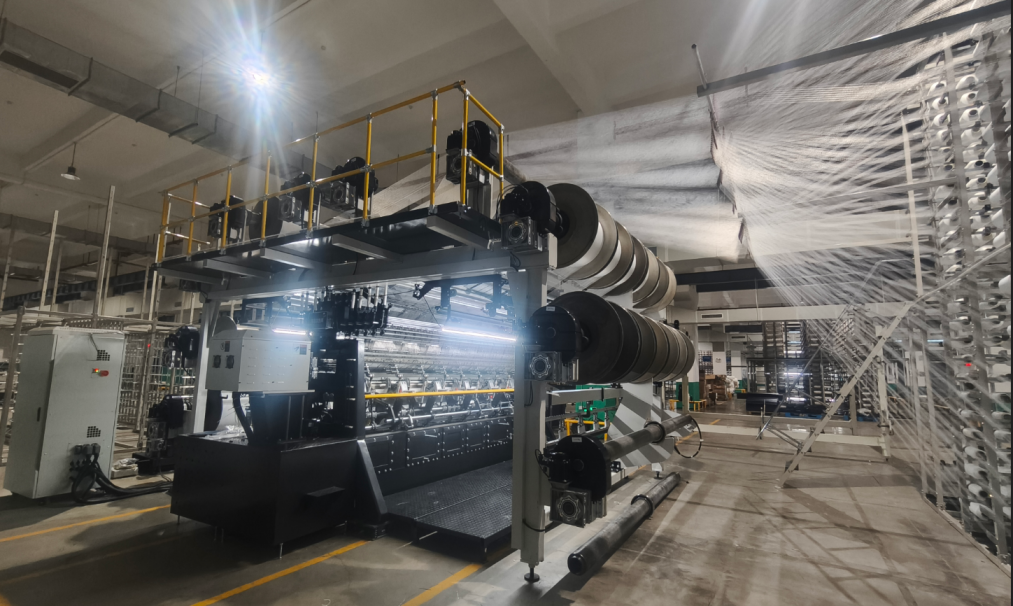
Configuration
| Item | Specification |
|---|---|
| Working width | 3454 mm (136") |
| Gauges | E18, E22, E24, E28 |
| Ground guide bars | 4 |
| Jacquard | 3 groups of piezo jacquard guide bars, split type |
| Needle bars | 2 latch needle bars |
| Stitch forming | GB3, GB4, JB5, JB6 on both needle bars |
| Comb bars | 2 knock-over comb bars, 2 stitch comb bars |
| Guide bar drive | Electronic, all bars shog up to 150 mm |
| Knock-over comb bar distance | 2-12 mm, adjustable |
| Trick plate | Central, adjustable |
| Control | GrandStar COMMAND SYSTEM |
What the second needle bar changes
On a single needle bar machine, structure and figure compete for the same loops. Add a second latch needle bar and you get two independent fabric faces plus the yarn that ties them together, so the pile or spacer layer stops being a compromise against the ground.
That is why stitch forming here is distributed: GB3, GB4, JB5 and JB6 all form stitches across both needle bars. Each face is being built by dedicated bars rather than by one bar alternating, which is what keeps loop geometry consistent when the pattern gets dense.
The practical consequence for a mill is range. The same frame covers lace, net, mesh, spacer and heavier technical constructions, and moving between them is a pattern and setting change instead of a different machine.
Three jacquard groups, and when you need them
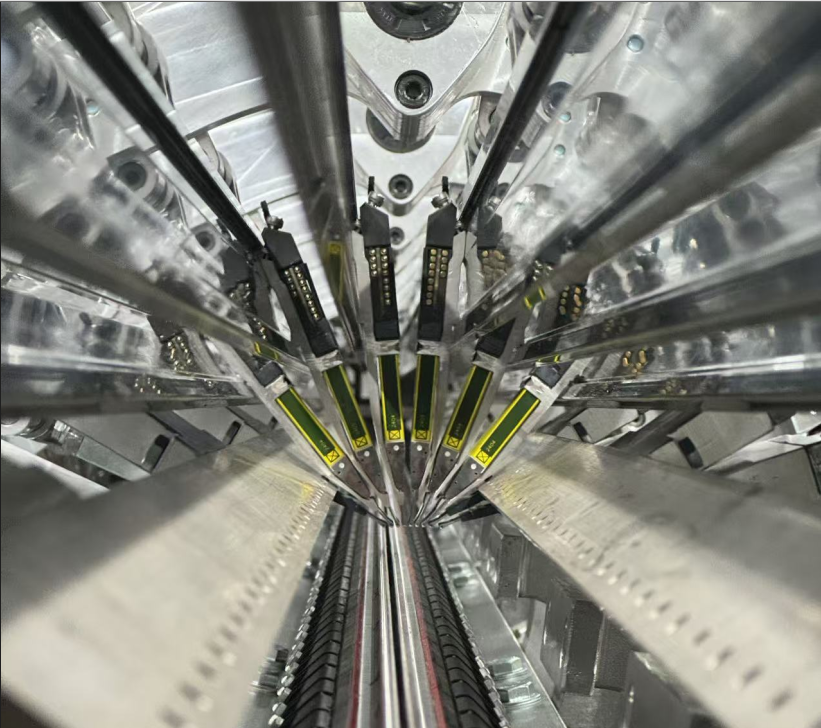
The 7/3 carries three groups of piezo jacquard guide bars in split type, on top of four ground guide bars. Three groups is not simply more of the same thing – each group can shog on its own, so figure can be built in layers rather than in one plane.
Split type matters for edge definition. Jacquard authority is divided across the width instead of driven as a block, which is what holds aperture edges clean on fine motifs.
The trade is straightforward: more jacquard groups means more pattern freedom and more to set up. If your program is repeat commodity mesh, that capability sits idle and you are paying for it.
Setting the fabric
The knock-over comb bar distance, adjustable from 2 to 12 mm, is the setting that governs the separation between the two faces. On a double needle bar machine that single value is the difference between a thin double-face fabric and a structural spacer, so it is the first thing to fix when a sample comes back wrong on thickness.
The central trick plate is separately adjustable, giving finer control over knock-over and loop release. Two knock-over comb bars and two stitch comb bars support that on both faces.
Pattern movement is electronic, with all guide bars able to shog up to 150 mm, run from the GrandStar COMMAND SYSTEM. Setup, control and adjustment of the electronic functions sit on one interface, so a pattern returns to the same settings on the next run rather than being re-found by trial.
Applications
- Fashion and lace – figured fabrics where motif clarity has to survive a long run.
- Home textiles – curtain, upholstery and similar goods.
- Sports and footwear – spacer and mesh where compression behaviour is the specification.
- Technical and industrial – net and reinforced structures, including automotive interior and safety-related fabrics.
Choosing between configurations
- If your fabrics are figured on both faces or need layered pattern effects, then the three jacquard groups are the reason to specify the 7/3 rather than a lighter jacquard arrangement.
- If your requirement is spacer thickness rather than pattern, then read the 2-12 mm knock-over comb bar range first and treat the jacquard count as secondary.
- If you are running plain net or commodity mesh at volume, then a simpler double needle bar configuration will do the same job with less to set up.
Where this does not apply: single-face flat fabric does not need two needle bars at all, and gauge and working width are fixed at the frame, so they belong to the configuration decision rather than to later optimisation. Achievable thickness, hand and pattern resolution always depend on yarn and construction as well as machine setting – confirm them on a sample before committing a program.

Who builds it
Grand Star Technology has built warp knitting machinery since 2012 and is based in Fujian, China. The company works with partners in the United States, Japan, Turkey, Vietnam, Indonesia, India, Colombia and Mexico.
If you are evaluating a double needle bar warp knitting machine, send the fabric you need to make – construction, thickness, gauge, width – and we will work back from that to the guide bar and beam configuration, rather than starting from a spec sheet.
Frequently Asked Questions
What is a double needle bar warp knitting machine used for?
Two needle bars let the machine knit two fabric faces at the same time and connect them, which is what makes spacer, tubular and figured double-face fabrics possible in one pass. Typical output covers lace, net, mesh, spacer fabrics for sportswear and footwear, home textiles, and technical constructions including automotive interior and safety fabrics.
What is the difference between the ground guide bars and the jacquard bars?
On the Triple Jacquard Double Raschel 7/3 there are four ground guide bars that build the base structure, plus three groups of piezo jacquard guide bars in split type that handle the figuring. Each jacquard group can shog independently, so pattern can be built in layers instead of in one plane.
How thick a spacer fabric can this machine produce?
The knock-over comb bar distance is adjustable from 2 to 12 mm, and that setting governs the separation between the two fabric faces. The central trick plate is separately adjustable for finer knock-over control. Actual thickness also depends on yarn and construction, so confirm it on a sample rather than from the adjustment range alone.
What working width and gauges are available?
3454 mm (136 inches) working width, in gauges E18, E22, E24 and E28. Both are fixed at the frame when the machine is configured, so match them to your target fabrics before ordering.
How far can the guide bars shog?
All guide bars are driven electronically and shog up to 150 mm, controlled through the GrandStar COMMAND SYSTEM, which handles setup and adjustment of the electronic functions from one interface. Wide shog is what makes large-repeat pattern layouts practical.

Hey, I’m Vincent!
Solving complex challenges with precision and creativity in the warp knitting industry. Passionate about advancing textile engineering and turning innovative ideas into reality. Shaping the future of warp knitting.


