



Warp Knitting Needles: The Three Groups and How to Order Them

Warp knitting needles fall into three working groups, and the group decides what you can order: the needles that form the loop (compound, latch and bearded types), the guide needles that steer the yarn into the needle, and the sinkers and retaining parts that hold the fabric while the loop is made. Ask for "needles" without saying which group you mean and you will get the wrong quotation.

This page sorts the whole family the way a spare-parts request has to be sorted: by function first, then by the machine and system the part belongs to.
The three functional groups
| Group | What it does | Typical members |
|---|---|---|
| Loop-forming needles | Draw the new loop through the old one | Compound needle, latch needle, bearded needle |
| Guide needles | Lay the yarn into the needle along a controlled path | Guide needle for pattern bar, guide needle for piezo Jacquard, guide needle for stitch bonding |
| Holding and closing parts | Hold the fabric and lock the stitch while the loop forms | Sinker needle and sinker module, knock-over sinker, retaining pin, closing wire |
A compound needle is made of two parts that move against each other to open and close the hook. That two-piece action is what makes it suitable for high-speed running where loop control has to stay predictable, and it is the common choice on both tricot and Raschel machines. Latch and bearded needles solve the same problem with a different mechanism, which is why a machine built around one of them will not simply accept another.
The sinker: the part that decides fabric texture
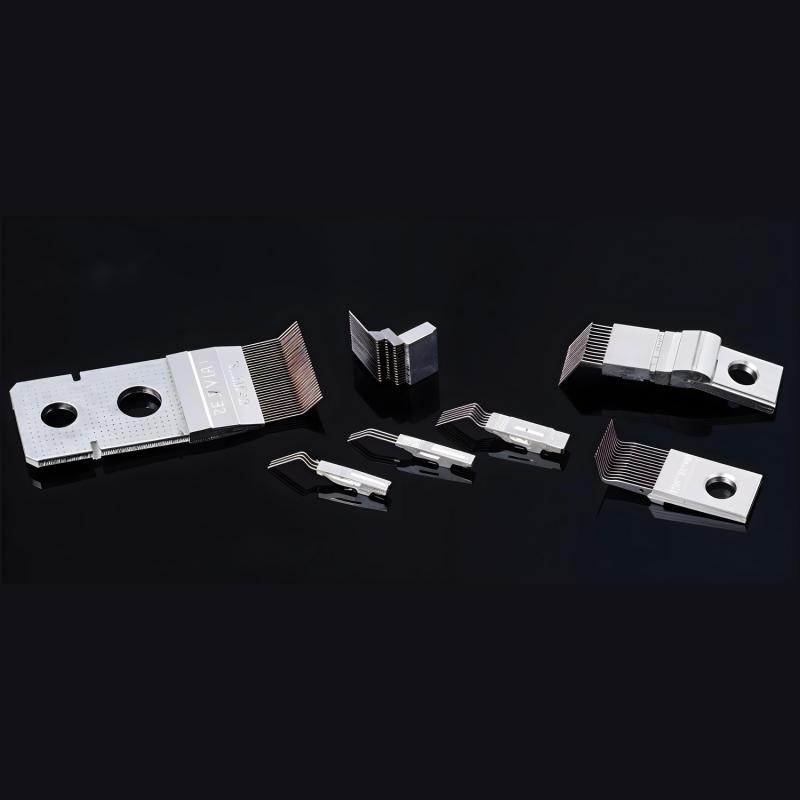
The sinker needle does more than hold things still. It holds and guides the old loops while the new ones are being formed, and it sets the depth of the yarn bend, which is what you feel as fabric texture. On some machines the sinker also controls loop length and density, so a worn or wrongly specified sinker shows up as a fabric-hand complaint long before anyone calls it a parts problem.
Tricot and Raschel machines use sinkers differently. Tricot machines run sinker modules for close control of smooth, even fabric. Raschel machines use a wider variety of sinkers, each with its own support function, which is why a Raschel parts list is longer and why cross-referencing by machine model matters more on that side. Our page on sinker needles and sinker modules covers the module form in more detail, and the broader warp knitting machine parts overview shows where the sinker sits among the other bars.
Jacquard and pattern bar systems need their own guide needles
Piezo Jacquard systems produce detailed, multicolour patterns by controlling each yarn path individually, and the guide needle for piezo Jacquard is built for that job: speed and path accuracy on every single yarn. It is the part to specify when design precision drives the order, as it does on lace and decorative fabric.
Pattern bar systems have the same requirement expressed differently. The guide needle for pattern bar keeps every yarn on its intended route so that complex structures stay stable, which is why these turn up mostly on Raschel machines.
Retaining pins and closing wires belong to the same conversation even though they are small. They help lock the stitch in place and hold fabric shape, and they appear most often in Jacquard and pattern knitting. Loop stability is difficult to hold without them, so they are worth listing explicitly on a parts order rather than assuming they come along with the needles.
Stitch bonding uses the same names for different parts
Stitch bonding combines warp knitting with nonwoven layers, and the parts are sized for that. The compound needle for stitch bonding is built to work through thick layered structures and to pull the layers into a tight bond, which is why it is a standing item in automotive and filtration work. The guide needle for stitch bonding does the placement side of the same job: exact yarn positioning across layers, at the speeds these lines actually run.
Sinkers, retaining pins and knock-over sinkers work as a set here rather than individually. They stabilise the yarn and keep the fabric layers aligned during bonding. Ordering one of the three without the others is a common way to end up with a machine that runs but does not hold alignment.
Choosing and ordering: what to state on the request
Needle type affects fabric strength, loop density and production speed, and the yarn type and fabric design decide which of those matters most on your line. Two rules keep the selection honest: the needle must match the machine, and it must match the fabric you are actually running rather than the fabric the machine was bought for.
Conditional conclusion
If you run a tricot machine on smooth apparel or automotive fabric, then your recurring items are the compound needle and the sinker module, and texture complaints should send you to the sinker before anything else.
If you run Jacquard or pattern bar work, then the guide needle type is the specification that matters, and retaining pins and closing wires belong on the same order as consumables rather than as spares.
If you run stitch bonding, then quote the compound needle, guide needle and the sinker or retaining set as one group, because they are matched to the layer thickness you are bonding.
This does not apply if your machine uses latch or bearded needles as its loop-forming element. Those are a different mechanism, and compound needle part numbers will not cross over.
When you send a request, state the machine make and model, the machine gauge, which bar or system the part belongs to (needle bar, pattern bar, Jacquard, sinker), and the yarn you are running. The full parts range is on our group site under warp knitting spare parts. If you are unsure which group your part belongs to, send a photograph of the part in the machine and the model plate, and we will identify it from there.
Frequently Asked Questions
What are the main types of warp knitting needles?
They divide into three functional groups. Loop-forming needles draw the new loop through the old one and include compound, latch and bearded types. Guide needles lay yarn into the needle along a controlled path and include pattern bar, piezo Jacquard and stitch bonding versions. Holding and closing parts include the sinker needle and sinker module, knock-over sinkers, retaining pins and closing wires.
What does a compound needle do differently?
A compound needle is made of two parts that work together to open and close the hook. That gives controlled, flexible loop formation at high speed, which is why it is a common choice on both tricot and Raschel machines.
Why is the sinker blamed for fabric texture problems?
The sinker holds and guides the old loops while new ones form, and it sets the depth of the yarn bend, which is what the hand of the fabric comes from. On some machines it also controls loop length and density, so a worn or wrongly specified sinker shows up as a texture complaint rather than an obvious parts fault.
Do tricot and Raschel machines use the same sinkers?
No. Tricot machines use sinker modules for close control of smooth fabric, while Raschel machines use a wider variety of sinkers, each with a different support function. That is why Raschel parts lists are longer and have to be cross-referenced against the machine model.
Which needles does a stitch bonding machine need?
The compound needle for stitch bonding, which is made to work through thick layered structures, and the guide needle for stitch bonding, which places yarn precisely across the layers. Sinkers, retaining pins and knock-over sinkers should be ordered with them as a matched set, since they keep the layers aligned during bonding.

Hey, I’m Vincent!
Solving complex challenges with precision and creativity in the warp knitting industry. Passionate about advancing textile engineering and turning innovative ideas into reality. Shaping the future of warp knitting.


