



Warp Knitting Machine Parts: What Wears, What Fails, What to Stock

Most warp knitting machine parts questions are really one of three questions: what is causing this defect, which family does the part belong to, and how much of it should sit on a shelf. This page answers those in that order, because that is the order they come up on a running line.
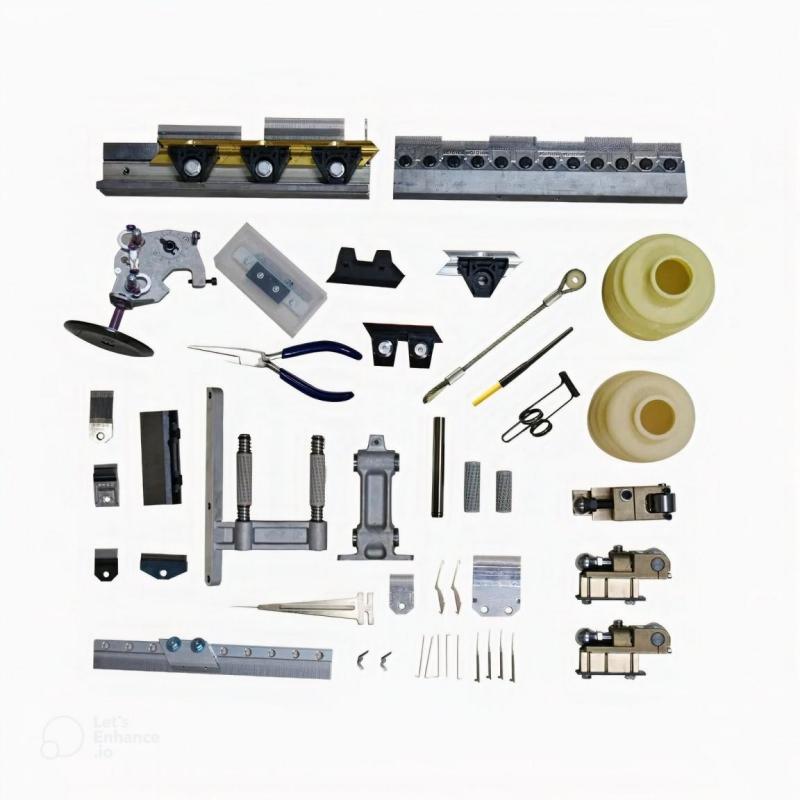
The parts that form the fabric, and what each one is doing
Loop formation is a chain of timed contacts. Needles form the loops. Guide bars move the yarn across to the needles. Sinkers hold the fabric down while the loop is made, so it does not lift with the needle. The take-up rollers pull the finished fabric out to make room for the next course, and the let-off system feeds yarn in at a controlled tension. Cams and gearing decide when each of those happens.
The timing is the part that gets underestimated. If one element moves early or late, the loop does not form correctly, and the resulting fault looks like a needle problem when it is a gearing problem. Before replacing an element, check whether the fault repeats at a fixed position across the width – a positional fault points at the element, a fault that wanders points at timing or tension.
Part families you will actually order from
| Family | Typical items |
|---|---|
| Forming and looping | Compound needle, closer needle (core needle), sinker needle, hook needle, latch needle |
| Guiding and patterning | Guide needle, guide needle for pattern bar, guide needle for piezo jacquard, guide needle for stitch bonding, pattern disc, piezo jacquard unit |
| Bars and beams | Latch needle bar, carbon-fibre needle bar, hanger bar, forged beam, cast beam |
| Motion and support | Beam shaft connector, push rod, bearing and bushing, ball cage, swivel frame |
| Tension and feeding | KFD yarn tensioner, yarn tensioner sliders, yarn drop stop detector, warping creel, beam chuck |
| Wear protection and routing | Ceramic eyelet plate, porcelain tube eyelet, collar with slit, eyelet collar, ceramic yarn guides |
| Edge, safety and handling | Selvedge spreader device, cloth wrap for roller system, laser stop device, waste yarn winding machine |
| Stitch bonding specific | Closing wire, retaining pin, sinker and sinker parts for stitch bonding |
| Sealing and fluids | Oil bellow, oil bellow base |
Two notes worth carrying into a purchase order. Carbon-fibre needle bars lower moving mass and damp vibration at speed, which protects stitch geometry; standard bars cost less and are fine where speeds are moderate. Forged beams give the higher rigidity you want on fast sections, while cast beams are the value option where speed is not the constraint. Piezo jacquard units cover a gauge window from E12 to E34, so one unit usually spans fine to medium work without swapping core electronics.
Reading a defect back to a part
Most floor problems map to a small number of components.
| What you see | Where to look first |
|---|---|
| Dropped or malformed loops at a fixed position | Needle or sinker at that position; check for a bent or dulled element before anything else |
| Loops weak or yarn snapping across the width | Let-off tension: too loose gives weak loops, too tight snaps the yarn |
| Pattern drift and curling edges | Loose tolerances in guide or needle elements; also check guide bar alignment to the needles |
| Streaks with no obvious element fault | Micro-play in bearings, bushings and ball cages; and needle bar flex at speed |
| Fuzzing, kinking, rising yarn breaks | Grooved ceramics in the yarn path, or static building during warping |
| Fabric stretched or the machine jamming | Take-up roller speed out of step with the rest of the machine |
| Parts running hot, wearing early despite correct dimensions | Wrong temper or inconsistent surface finish on the replacement part |
The last row is the one that costs the most time. A part can be dimensionally correct on paper and still fail early because the material specification behind it was not controlled, and that failure looks exactly like a machine fault.
Static during warping: a small device with an outsized effect
Static build-up in warping attracts dust and causes erratic end drops that show up much later as knitting faults. The warping static eliminator uses high-voltage discharge to release ions that neutralise the charge on the yarn, working across a 30 to 50 mm range.
Placement is the whole job. It works best above the reed bracket, near the tension device, near the warp break stop, and at the rear reed – the four points where charge concentrates. Fitted there it keeps the yarn path straight, reduces kinking and pilling, improves warp length measurement, and takes stress off elements further down the line.
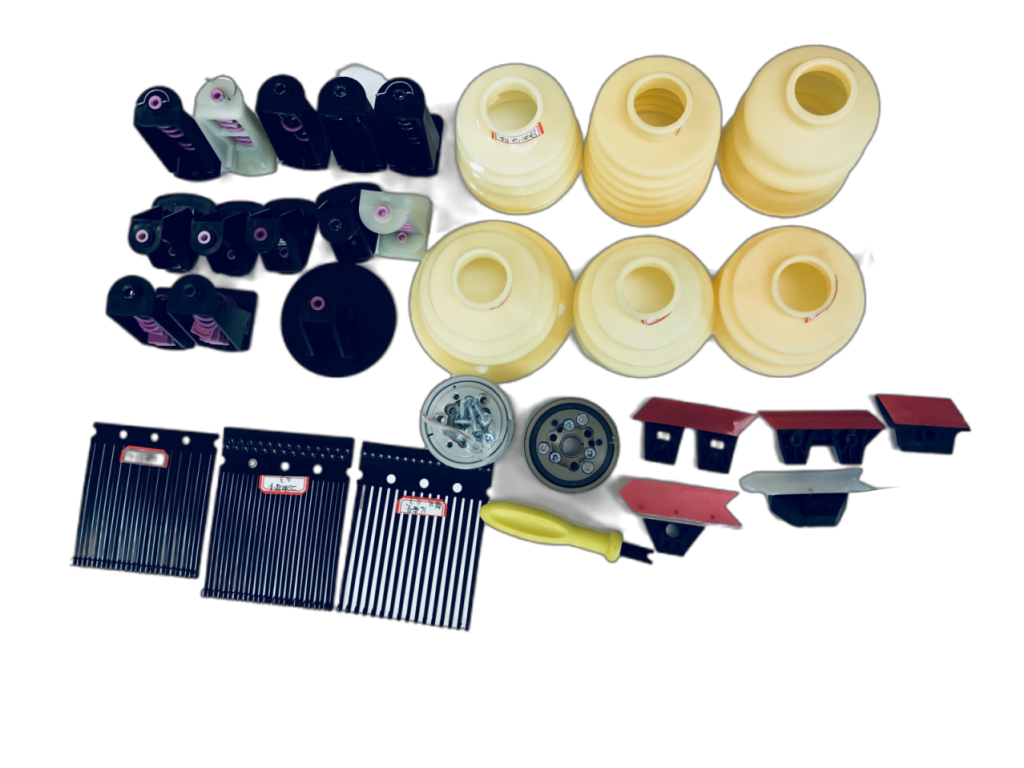
Maintenance that prevents the parts order
Lint is the first enemy. It builds fast, blocks moving parts and eventually stops the machine, and a daily pass with a soft brush and air handles it. Lubrication comes second and in that order – clean first, then oil, and only a few drops at the right points. Over-oiling collects lint and creates the problem it was meant to prevent.
Replacement is the third discipline. Keep a log of when each element was last changed and replace on interval rather than on failure. A planned ten-minute change beats an unplanned stop of several hours, and the log is what turns a spares budget into something you can forecast rather than react to.
Where wear is predictable, build kitted spare sets per machine, based on shift hours, yarn type and your own defect reports. That is also how operators learn to spot early needle or sinker fatigue and reset tensioners correctly instead of waiting for a defect to appear in the roll.
How to judge a parts supplier before the order
Price is visible and lifetime value is not, so ask for the things that predict it:
- Specification control – drawings, hardness and surface finish documented for each part
- Material matching – carbon fibre where low mass matters, forged beams where rigidity matters
- Tolerances and traceability – lot numbers and test records for needles, sinkers, guides and bars
- Tension stability – tensioners and sliders that hold their setpoint over a long run
- Edge quality – selvedge spreader validated on your yarn mix and widths
- Safety proven at your line speed – laser stop device tested at the speed you actually run
- Stock and lead time – regional inventory and pre-kitted spares you can plan around
Counterfeit look-alike parts fail against most of that list at once: they carry the right dimensions and the wrong temper, so they snap or dull early. Traceability to a lot number is the cheapest protection against repeating that purchase.
Where our parts come from
Grand Star Technology has built warp knitting machines and control systems from Fuzhou, Fujian since September 2012, with a team of more than 50 and quality management to ISO9001. Machines and parts ship to customers in the United States, Japan, Turkey, Vietnam, Indonesia, India, Colombia and Mexico.
Drawings are locked, hardness and finish are documented, and parts are tested under real warp knitting conditions with batches traceable to a lot number. The full catalogue of elements and consumables is on the group warp knitting spare parts pages, and our own spare parts overview covers the wear items in more detail.
When you enquire, send your machine models, gauge and the defect you are chasing rather than a part name alone. Half the orders that come back for exchange were ordered by name when the actual fault was in a different family.
Frequently Asked Questions
Which warp knitting machine parts wear out fastest?
The elements in the yarn path and the loop-forming set: needles, sinkers, guide needles, and the ceramics that yarn slides across. Ceramic eyelet plates and porcelain tubes groove over time and start fuzzing yarn, and needles dull or bend. Track them by shift hours and yarn type rather than by calendar, and replace on interval instead of on failure.
How do I tell which part is causing a fabric defect?
Start with position. A fault that repeats at a fixed position across the width points at the element at that position, usually a needle or sinker. A fault that wanders points at timing, tension or take-up. Streaks with no obvious element damage usually trace to micro-play in bearings, bushings and ball cages, or to needle bar flex at speed.
Should I buy a carbon-fibre needle bar or a standard one?
Carbon-fibre needle bars lower moving mass and damp vibration, which protects stitch geometry at higher speeds. Standard bars cost less and are adequate where speeds are moderate. The same trade-off applies to beams: forged beams give higher rigidity for fast sections, cast beams are the value option where speed is not the limiting factor.
Where should a warping static eliminator be installed?
At the four points where charge concentrates: above the reed bracket, near the tension device, near the warp break stop, and at the rear reed. It works across a 30 to 50 mm range using high-voltage discharge to neutralise charge on the yarn, which reduces kinking, pilling and end drops and improves warp length measurement.
What should I check before ordering spare parts from a new supplier?
Ask for documented drawings, hardness and surface finish; lot numbers and test records for needles, sinkers, guides and bars; proof that tensioners hold setpoint over long runs; and a stated lead time backed by regional stock. A part with correct dimensions but uncontrolled temper fails early and the failure looks exactly like a machine fault.

Hey, I’m Vincent!
Solving complex challenges with precision and creativity in the warp knitting industry. Passionate about advancing textile engineering and turning innovative ideas into reality. Shaping the future of warp knitting.


