



Tricot Machines for Home Textiles: Advanced Technology for Better Textile Production

A Tricot Machine for Home Textiles is not just a knitting device; it is a production platform that shapes lead time, fabric consistency, and waste levels. At Grand Star Technology, we have focused on warp knitting innovation since 2012, because home textile production needs both design freedom and industrial discipline.
The Market Pull: Home Textiles Demand Speed and Consistency
Home textiles look “traditional,” but the supply chain is not. Bedding, curtains, and upholstery respond to seasons, trends, and promotions, and buyers expect stable quality from batch to batch.
The market opportunity is measurable. Fortune Business Insights values the global home textiles market at USD 218.52 billion in 2024, and projects it to reach USD 338.37 billion by 2032 (CAGR 5.60%). Asia Pacific held a 43.74% market share in 2024, highlighting how concentrated capacity can be.
When the market is this large, small improvements in uptime, tension stability, and defect control can reshape profitability. A modern Tricot Machine for Home Textiles becomes a practical tool for scaling both volume and product variety.
What a Tricot Machine for Home Textiles Must Deliver
Warp knitting forms fabric by feeding many yarns in parallel, and each needle is fed by its own end of yarn. A widely used teaching deck from North Carolina State University explains that fabric structure is created when guide bars “shog” between needles, moving yarn position from one needle to another. That motion is where pattern control starts.
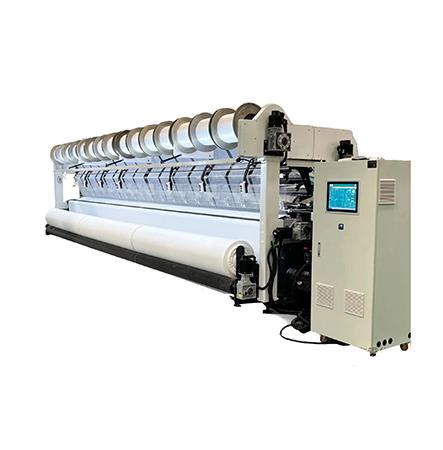
When we explain Tricot Machine for Home Textiles capability to clients, we start from outcomes:
✓Predictable fabric hand and appearance across long runs
✓Faster pattern switching for new collections and sampling
✓Tight tension control to prevent ripples, stripes, and distortion
✓Real-time defect discovery, so problems stop early
✓Clear, operator-friendly settings that reduce training time
✓Energy-aware drives that support long-term cost control
This is why control systems, monitoring, and smarter drives are becoming standard in advanced warp knitting lines.
Three Guide Bars: Pattern Freedom Without Losing Stability
A three-guide-bar tricot architecture is a practical balance for home textile fabrics. It expands pattern and texture options while staying efficient for continuous production.

Machines like the GS-HKS3 and GS-HKS3-M reflect this 3-bar concept. They support pattern discs or EL drives, so mills can select how they want to build and change designs.
Needle technology is a major lever for fabric quality. Our reference design uses an advanced needle bar arrangement with compound needles, supporting controlled stitch formation and surface variation. Groz-Beckert summarizes customer benefits of compound needles as results that production teams care about: more uniform loop structure, less downtime, and higher productivity.
For home textiles, that extra control supports products like upholstery fabrics, curtains, and bedding. It is especially helpful when you want larger patterns and a controlled surface feel, but still need stable, repeatable yardage.
Electronic Take-Up and Let-Off: The Hidden Key to Stable Yardage
Home textile rolls must remain stable across long yardage. If tension drifts, defects may appear as waves, uneven density, or shape distortion—sometimes only after dyeing or finishing. That is why we treat tension control as a first-class production parameter.
In the 3-bar tricot machine concept, fabric take-up is electronically controlled to maintain a consistent structure through knitting. Yarn let-off is adjusted with each warp beam, keeping yarn feeding accurate and balanced, and helping avoid unacceptable fabric contours.
For your operation, this stability becomes money. You reduce off-standard fabric, protect finishing yield, and make output planning more predictable across shifts.
In-Line Monitoring and Smart HMI: Quality Control at Machine Speed
Finding a defect after the roll is finished is expensive. This is why the industry keeps moving toward in-line inspection and machine vision, where problems can be detected while fabric is being produced.
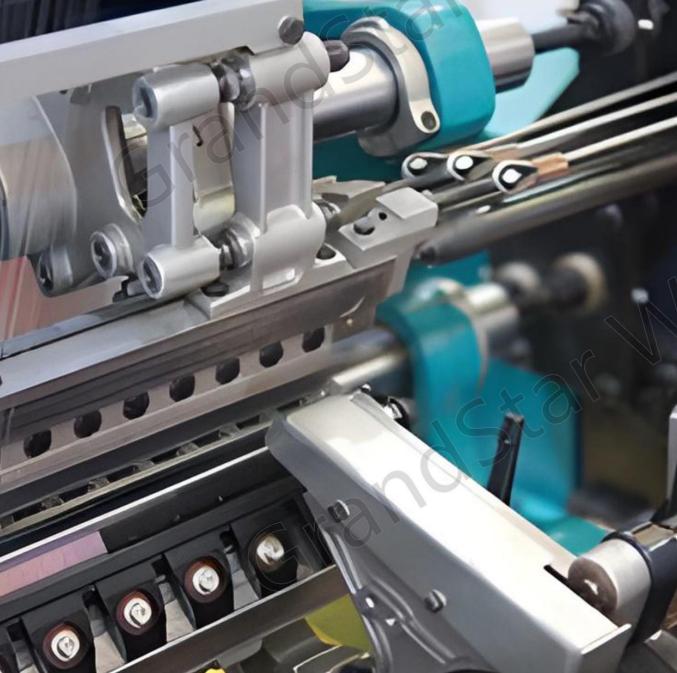
In our tricot configuration, Laserstop and camera integration can support quality monitoring and immediate response when abnormal conditions appear. Our camera detection system is positioned as real-time defect detection for tricot and warp knitting applications, aligning with the broader “inspect more, sample less” direction in industrial inspection.
To make this usable on the shop floor, the GrandStar® COMMAND SYSTEM provides an advanced HMI for accessing electronic functions and settings. In practice, a clear interface reduces missed settings and supports faster, safer changeovers.
Energy Efficiency and a Clear CTA for Your Next Step
Textile production relies on motor-driven equipment in winding, knitting, and take-up. That is why speed-regulated drive systems and variable frequency drives are widely adopted preventing energy waste by matching speed to the required load, while also improving process stability.
If you are planning to upgrade a Tricot Machine for Home Textiles line, start with a focused technical conversation. Share your target fabrics (curtains, bedding, or upholstery), your yarn plan, and your biggest defect risks. We will help you map those needs to a configuration that is easier to run, easier to monitor, and easier to scale.
✓Request a fabric capability review for your home textile categories
✓Ask for a live demo of our HMI and monitoring approach
✓Send a short list of your current defects, and we will propose a control plan
Contact Grand Star Technology to discuss your Tricot Machine for Home Textiles roadmap—because better fabric quality starts with better machine control.

Hey, I’m Vincent!
Solving complex challenges with precision and creativity in the warp knitting industry. Passionate about advancing textile engineering and turning innovative ideas into reality. Shaping the future of warp knitting.


