



Geogrid Warp Knitting Machine: Gauges, Widths and Beam Setup

Two different machines are both sold as a geogrid warp knitting machine: a double needle bar raschel for net, and a raschel net machine running latch needles. They overlap in what they can produce, but not in width range, not in gauge range, and not in whether they can take film instead of yarn.
Get that choice wrong and you do not lose a feature — you lose either the width or the aperture your customer specified.
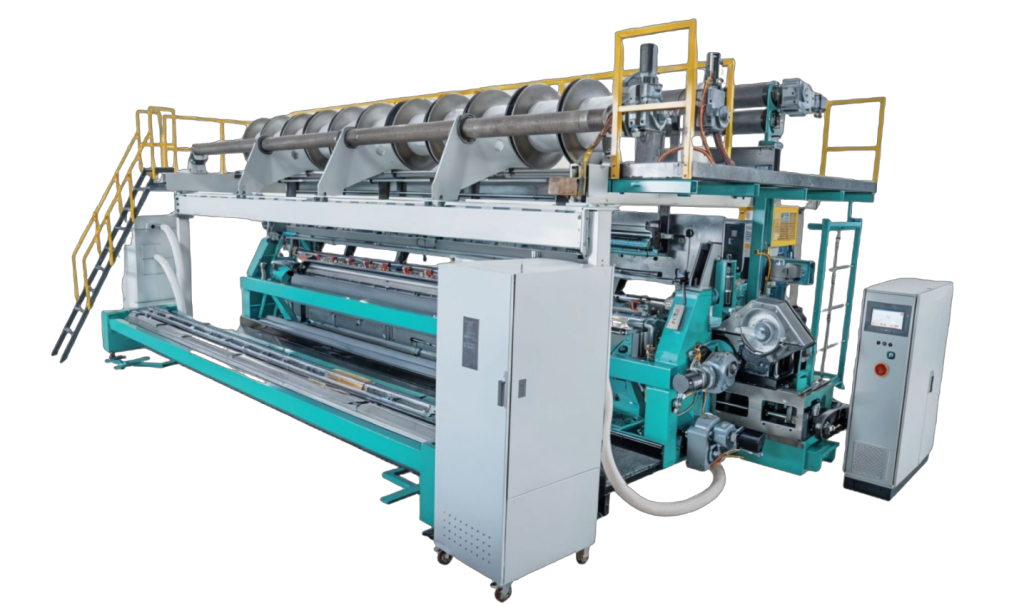
The two platforms, side by side
| Double Needle Bar Raschel for Net | Raschel Net Machine, latch needle | |
|---|---|---|
| Working widths | 130″, 180″, 210″, 256″ | 181″, 205″, 268″, 283″, 335″, 413″, 503″ |
| Gauges | E2, E3, E6, E9, E12, E18 | E3, E6, E8, E10, E12, E18 |
| Needle arrangement | Double needle bar | Latch needles, mounted in blocks or inserted individually |
| Bar set | Not published for this platform | Single needle bar, knockover comb bar, slider bar, stitch comb bar; 2 to 8 bars |
| Warp beams | 4, 6, 8 or 9 positions, 32-inch beams | 2 to 8, free-standing, 812 mm (32″) flanges |
| Yarn let-off | One drive per beam | Electronic, geared motor |
| Pattern drive | GrandStar® COMMAND SYSTEM | N-drive with 2 to 8 pattern discs and a tempi change gear |
| Film handling | Not published for this platform | FTL system cuts and stretches film in step with knitting |
| Take-up | Motor with four rollers | Friction drive on a servomotor, under motion control |
Which one your product picks for you
Width settles most of these decisions before anything else does. Above 256 inches the double needle bar platform is simply out, and the latch needle machine — 268, 283, 335, 413 and 503 inches — is the only one on the list that reaches.
Gauge settles the rest at the other end. E2 exists only on the double needle bar platform; the latch needle machine starts at E3. If your grid specification calls for the coarsest aperture in the range, that single line decides your platform.
And if you extrude and slit film rather than feeding yarn from a creel, the FTL system on the latch needle platform cuts and stretches the film in step with the knitting process. Nothing equivalent is published for the double needle bar machine.
Yarn feed, and what feeds it
Both platforms are run with HDPE, polyester and the other high-tenacity yarns used in construction fabrics. On the latch needle machine the yarn feeding section runs three or four feeding positions, each carrying three rollers, and works together with a creel.
Fault detection is where the money is saved rather than earned: a Laserstop system watches the process and halts the machine when something goes wrong, and the electronic pattern drive keeps the repeat honest at speed. On a grid that is going under a road, a fault that runs for a hundred metres before anyone notices is not a scrap problem, it is a liability problem.
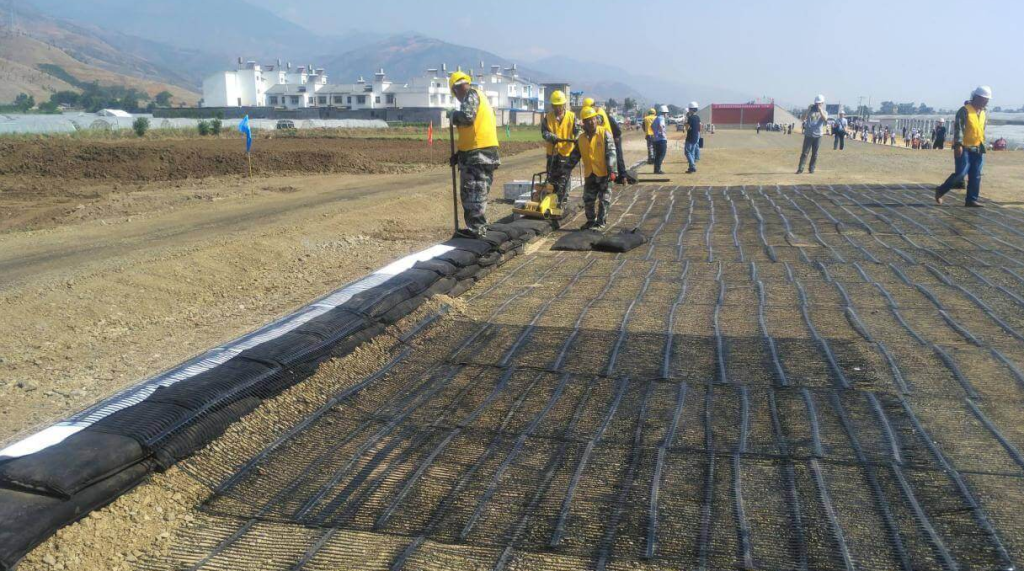
What the machine needs from your building
On the geo textile configuration of this platform the published operating envelope is 25 ℃ ± 6 ℃ and 65% ± 10% relative humidity, on a three-phase 380 V ± 10% supply with a 25 kVA load. Working widths there run from 181″ to 275″, with compound needles and up to eight guide bars supporting GB1 to GB4 stitch formation, electronically controlled let-off at up to four warp beam positions, a motion-control take-up and a floor-standing batching unit.
Check the supply and the room against those figures before the crate ships, not after. Voltage and humidity are cheap to fix in a drawing and expensive to fix around an installed machine.
If your grid spec is fixed, buy for width; if it is not, buy for range
If you produce one grid specification at volume, then buy the narrowest machine that covers the width and the exact gauge the specification calls for, and put the money you save into beam positions so you stop less often.
If you serve varied civil work where aperture and width change job to job, then buy the wider latch needle platform and the larger bar count — 2 to 8 bars and 2 to 8 pattern discs is what lets one machine cover several specifications without a rebuild.
Neither rule holds if the grid is written into an engineering drawing you do not control. There aperture and gauge are given to you, and the only decision genuinely left open is width.
Related machines on this site
- Double needle bar raschel machine — the platform in the left-hand column above.
- Raschel warp knitting machine — where the net machines sit in the wider raschel range.
- Fishing net warp knitting machine — the same net principle for a different end use.
- Multi axial warp knitting machine — for reinforcement laid at set fibre angles rather than as a grid.
Send the grid specification — aperture, width, yarn and whether you feed yarn or film — and the platform choice usually resolves itself in one reply. Start from our contact page.
Frequently Asked Questions
What working widths can I get on a geogrid warp knitting machine?
It depends on the platform. The double needle bar raschel for net is built at 130, 180, 210 and 256 inches. The latch needle raschel net machine goes considerably wider: 181, 205, 268, 283, 335, 413 and 503 inches.
What gauges are available?
The double needle bar platform covers E2, E3, E6, E9, E12 and E18. The latch needle machine covers E3, E6, E8, E10, E12 and E18. If you need E2, only the double needle bar platform reaches it.
Can the machine run film instead of yarn?
Yes, on the latch needle platform. Its FTL system cuts and stretches film in step with the knitting process. No equivalent is published for the double needle bar machine.
What yarns does a geogrid machine handle?
HDPE and polyester are the usual choices, along with other high-tenacity yarns used in construction fabrics. The latch needle platform feeds through three or four feeding positions of three rollers each, working with a creel.
What power supply and room conditions does it need?
On the geo textile configuration the published envelope is 25 degrees C plus or minus 6, 65% relative humidity plus or minus 10, a three-phase 380 V supply plus or minus 10%, and a 25 kVA load. Confirm your supply against those figures before shipping.

Hey, I’m Vincent!
Solving complex challenges with precision and creativity in the warp knitting industry. Passionate about advancing textile engineering and turning innovative ideas into reality. Shaping the future of warp knitting.


