



Jacquard Tricot Machines for Sportswear – A Leap Forward in Textile Innovation

A Jacquard Tricot Machine for Sports wear is becoming a practical growth lever for mills that want breathable, stable, and clearly differentiated performance fabrics—without sacrificing the productivity advantages of warp knitting. Sportswear has moved beyond “basic stretch.” Product teams increasingly ask for ventilation where heat builds, supportive zones where movement loads the fabric, and a surface that still looks premium after repeated wear and washing.
This shift is happening in a market that keeps expanding. Grand View Research estimates the global sportswear market at USD 335.92 billion in 2023 and projects it will reach USD 646.01 billion by 2030 (a 9.9% CAGR from 2024–2030). Growth brings opportunity, but it also raises the baseline: brands compare fabrics on comfort, repeatability, and visible differentiation, not just price.
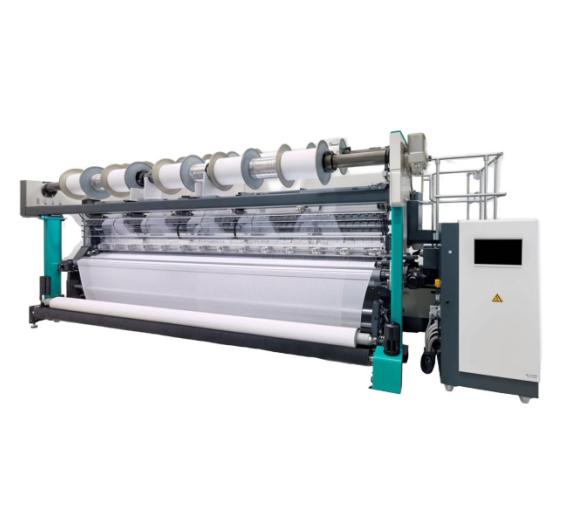
Why Sportswear Brands Are Asking for Zoned Performance
“Body mapping” describes a simple idea: build garments around where the body sweats, heats, and flexes. Academic discussions of sports clothing explain that body mapping can be achieved in several ways, including changing knit structures within a single fabric piece instead of stitching separate fabrics together. In commercial use, body-mapping textiles are often described as one continuous structure that combines thicker/thinner areas and different hole sizes, so ventilation and support can be delivered without adding seams or stitched-on panels.
For fabric producers, zoned performance is not only a design trend; it is a process strategy. When breathability, support, and texture are engineered into the knit itself, mills can reduce reliance on downstream lamination, bonding, or complex panel assembly—steps that add cost and create new defect opportunities. In other words, zoning can be as much about reducing quality risk as it is about adding features.
Why Tricot and Warp Knitting Fit Performance Specifications
Warp-knitted structures are widely used in performance textiles because they are typically run-resistant and more dimensionally stable than many weft-knit structures. Technical references also note that warp knits tend to be closer and flatter, with lower elasticity than typical weft knits. In practical terms, that combination supports cleaner surfaces, controlled stretch, and better resistance to distortion during wear and care.

Tricot is attractive for sportswear because it pairs speed with consistent appearance and handfeel. From a production standpoint, stability is not abstract: it reduces roll claims, limits distortion-related cut-and-sew issues, and supports tighter roll-to-roll tolerances. The key limitation of conventional tricot is that many constructions are uniform across the width, so functional zoning can end up depending on extra processes or multiple materials.
What Jacquard Adds to Tricot: Localized Structure and Visual Identity
A Jacquard Tricot Machine for Sports wear changes what “one fabric” can do. Jacquard patterning enables localized control, so airflow, elasticity, and texture can be placed where designers need them instead of staying uniform from selvedge to selvedge. In warp knitting, jacquard technology is commonly described as allowing mesh structures of different sizes to be arranged in desired positions—exactly the kind of placed openness that sportswear zoning depends on.
That localized control maps directly to sportswear requirements. Ventilation can be engineered into sweat-prone areas (such as underarms or upper back), while denser regions can be maintained for opacity, support, or abrasion resistance. Warp-knitting industry examples show how mesh constructions provide ventilation in selected areas while denser constructions add both function and visual effect—and how patterning facilities can place logos and lettering directly on the fabric surface.
Just as important, jacquard zoning can simplify garments. If the fabric itself delivers the zones, brands may need fewer fabric types and fewer build steps, which can reduce mismatch and variability across panels. This is one reason “engineered-in” performance is often paired with a premium positioning: it is not only about feel and function, but also about manufacturing consistency.

The Factory-Ready Factors: Repeatability, Tension Discipline, and Monitoring
Design freedom only pays when it repeats. When evaluating a Jacquard Tricot Machine for Sports wear, the most valuable questions are operational: How stable is stitch formation at speed? How disciplined is yarn tension? How quickly can operators detect and correct faults before they become waste? These factors decide whether zoning becomes a reliable product platform or a “nice sample” that struggles in bulk.
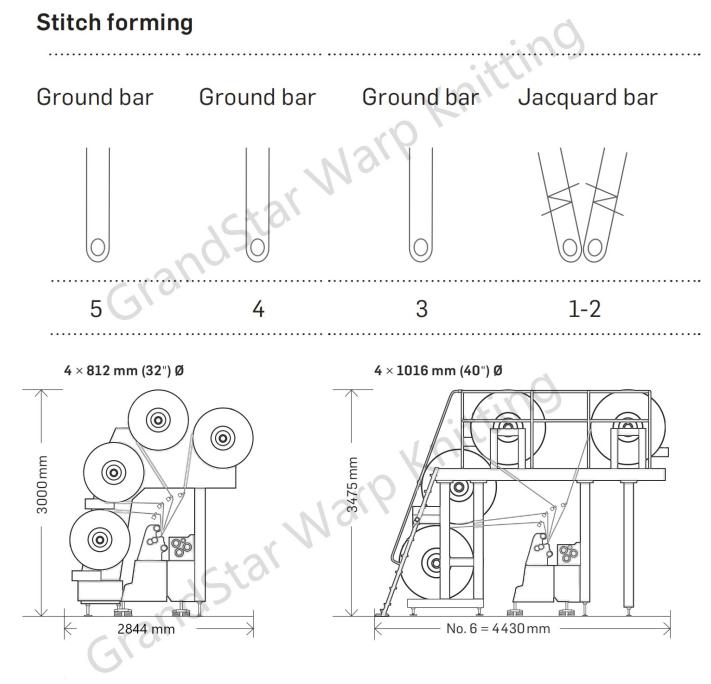
Public specifications for Grand Star Technology tricot platforms highlight stability-oriented knitting elements, including an individual needle bar with compound needles, a slider bar with 1/2-inch plate slider units, and a sinker bar with compound sinker units. The same sources describe guide bars and knitting elements made from carbon‑fibre‑reinforced materials, supporting lighter moving parts and smoother high-speed motion. For pattern drive, published options include an N-Drive using three pattern discs with an integrated tempi change gear, or an optional EL-Drive using three electronically controlled motors; with EL-Drive, guide bars are described as shogging up to 50 mm (optional extension to 80 mm).
Quality protection also depends on monitoring and controlled fabric handling. Public tricot specifications describe integrated monitoring options such as Laserstop and an integrated camera system, paired with an HMI operator interface (the GrandStar Command System). They also describe electronically controlled yarn let‑off drives at each warp beam position for tension regulation, and electronically regulated fabric take-up driven by a geared motor through a four‑roller configuration; a separate floor-standing cloth rolling (batching) device is also described for efficient fabric collection.
Planning the Upgrade: Beams, Power, and Support
Plant fit matters. Published tricot specifications list free-standing warp beam support options such as 4 × 812 mm (32″) as a standard configuration (with optional 4 × 1016 mm (40″) configurations on some listings). This kind of beam flexibility helps mills match beam selection to yarn planning, floor layout, and changeover strategy—especially when sportswear programs mix shorter trend runs with longer repeat orders.
Utilities and thermal stability should be planned early. Example tricot specifications list a total connected load around 25 kVA and a 380V ±10% three-phase power requirement, and some descriptions include an oil/water heat exchanger plus defined operating-condition ranges for temperature and humidity. Meanwhile, machine builders often position electronic guide-bar control and integrated software as tools to reduce time-to-market for patterned warp-knitted fabrics, which is relevant when sportswear calendars are tight and sampling cycles are short.
Support capability should be evaluated as seriously as machine capability. Grand Star states it provides local technical service teams in several regions (including India, Turkey, Egypt, Indonesia, and Pakistan) and indicates that coverage is expanding. Other public channels associated with the company describe local service spanning Vietnam and the United States as well, plus a workflow that emphasizes real-time online support first, with engineers dispatched when on-site action is required and periodic visits used to reinforce stability.
For development teams, the fastest evaluation approach is fabric-first: define the target garment use-case, list the functional zones required, confirm yarn availability, and map those needs to what a Jacquard Tricot Machine for Sports wear can produce as a single, repeatable structure. That keeps the project grounded in throughput, yield, and delivery performance—the factors that decide whether an innovation becomes a reliable sportswear program.

Hey, I’m Vincent!
Solving complex challenges with precision and creativity in the warp knitting industry. Passionate about advancing textile engineering and turning innovative ideas into reality. Shaping the future of warp knitting.


