



Maliwatt Stitch Bonding Machine: Width and Gauge Selection

Two decisions set what a Maliwatt stitch bonding machine will do for you, and both are made before the order is placed: working width and gauge. Everything else on the specification sheet supports those two. This page walks through how we size them against the product families the machine actually runs, then lists the full configuration.
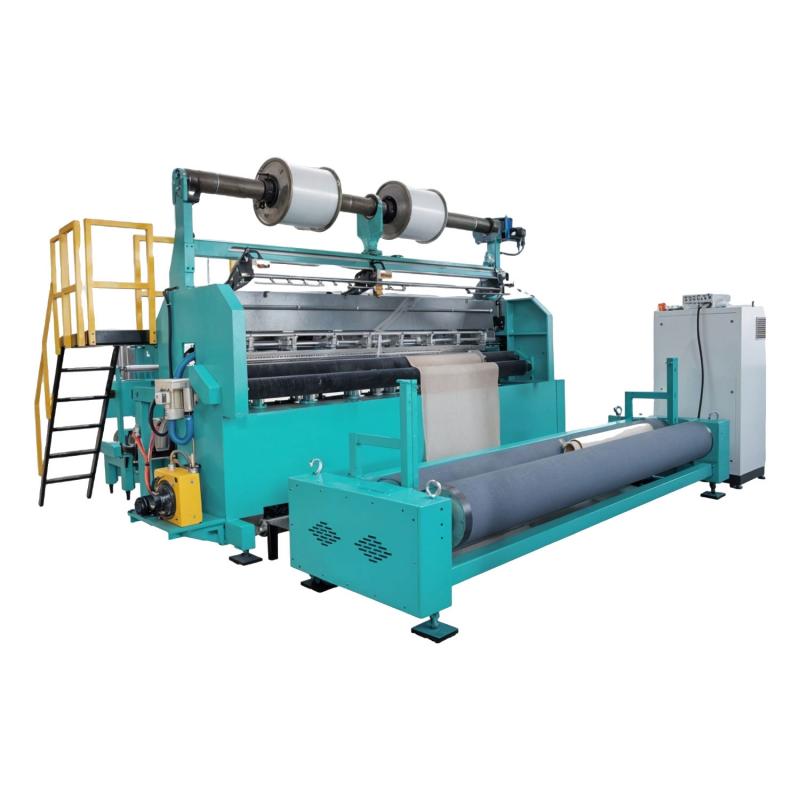
The four product families this machine is built around
- Stitch-bonded industrial fabrics — filtration, automotive and construction work, where dimensional stability is the specification that matters.
- Medical bandages — clean edges and uniform stretch, on substrates that punish any tension drift.
- Clothing interlining — stable interlayers that have to hold shape through sewing and wear.
- Curtain fabric — consistent stitching patterns, because drape shows every irregularity.
Those four sit at opposite ends of the same machine range, which is why width and gauge are not a single default. A plant running a mixed order book gets more out of matching assets to fabric than out of buying the widest machine available.
Choosing the working width
Seven widths are available: 2000, 2800, 3600, 4400, 4800, 5400 and 6000 mm. Wider is not automatically better. The width should follow the roll format your customers buy and the slitting plan you already run, because the waste created by trimming to an awkward width is permanent and shows up every shift.
Width also drives power. The main motor is 13 kW for widths from 2000 to 4400 mm, and 18 kW for 4400 to 6000 mm, so the width decision reaches the electrical planning for the hall as well as the fabric plan.
Choosing the gauge
Gauge options run F7, F12, F14, F16, F18, F20 and F22. In practice the finer end, up to F22, goes to fine medical substrates, while F7 to F12 is reserved for heavy industrial webs. Gauge sets stitch density, and stitch density is what the customer feels as hand and sees as coverage, so it deserves a decision rather than a default.
One practical benefit of staying within a single platform for a mixed portfolio: gauges and widths change, but the control philosophy and the operator interface do not. Cross-training a team across two machines of the same family costs far less than cross-training them across two brands, which matters whenever staffing is tight.
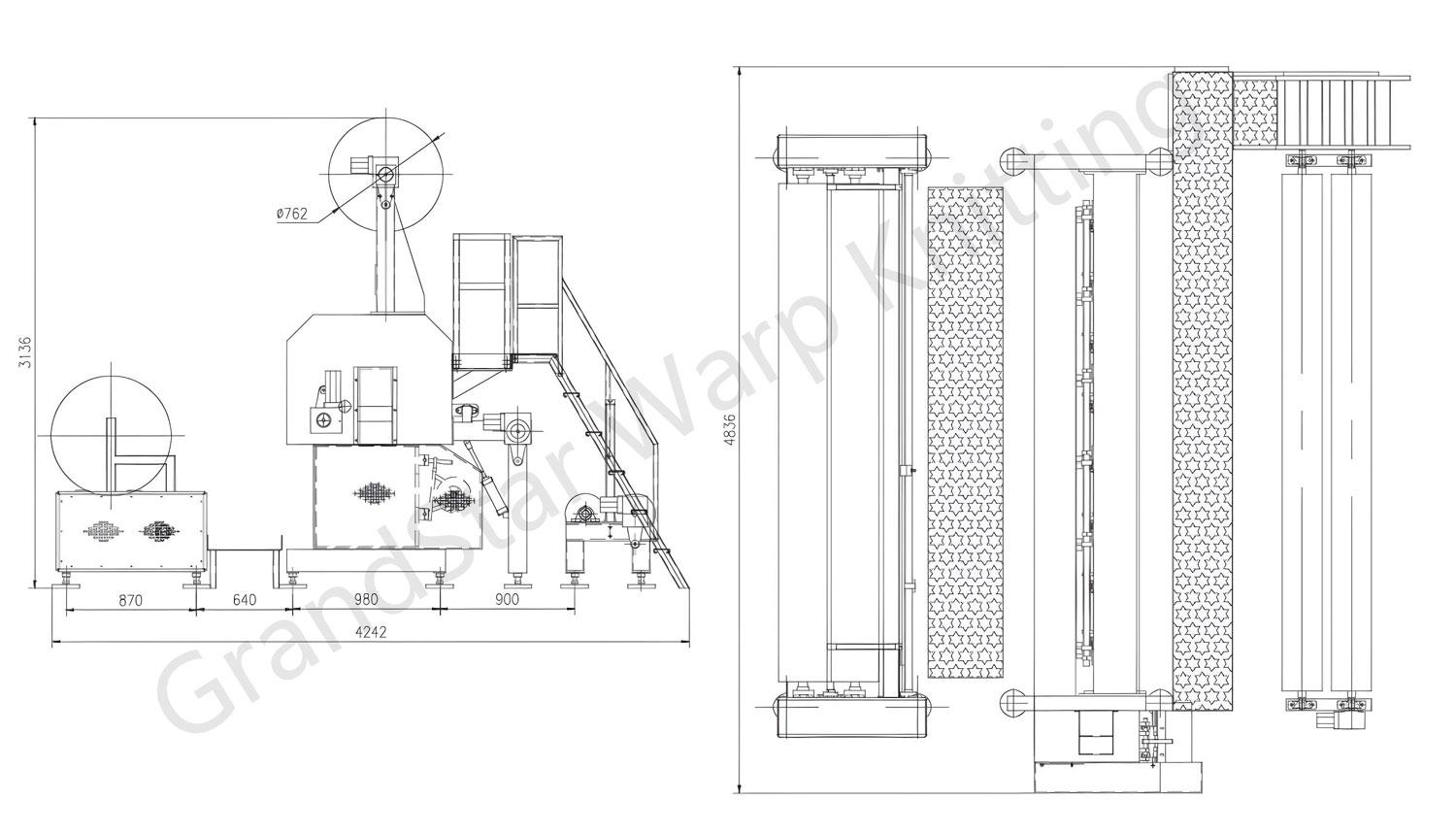
Full configuration
| Item | Specification |
|---|---|
| Working widths | 2000, 2800, 3600, 4400, 4800, 5400, 6000 mm |
| Gauges | F7, F12, F14, F16, F18, F20, F22 |
| Knitting elements | Compound needle bar, closing wire bar, knock-over sinker bar, supporting bar, counter-retaining bar, 1 or 2 ground guide bars |
| Pattern drive | N-drive with pattern disc, integrated tempi change gear drive, single pattern disc |
| Warp beam support | 1 or 2 positions for sectional use, max flange Ø30 |
| Yarn let-off | Electronically controlled, geared motor with frequency converter |
| Yarn stop motion | Electronically controlled, optional |
| Fabric take-up | Electronically controlled, geared motor with frequency converter |
| Batching | Standalone, friction drive with pressure roller, max batch Ø914 mm (36″), geared motor with integrated frequency converter |
| Machine control | Integrated computer for main drive, yarn feeding and take-up; touch screen with live production data |
| Main motor | 13 kW for 2000–4400 mm; 18 kW for 4400–6000 mm |
| Electrical | Speed-regulated drive with power-failure safety; single speed control through frequency converter |
Three items on that list are worth deciding early rather than late. The yarn stop motion is optional, and on sensitive constructions it is what stands between a stopped machine and a length of scrap. The second warp beam position buys you fast yarn or colour changes, which is only worth paying for if your order book is genuinely mixed. And the batching diameter of 914 mm sets how often the line stops for a roll change, which on long campaigns adds up faster than most quotations suggest.
Where the quality actually comes from
Loop formation happens at the elements, so the compound needle bar and the bars around it are where fabric problems begin and where any investigation should start. Replacement elements are listed under compound needles for stitch bonding, closing wire and knock-over sinkers, and the wider needle family is covered in our warp knitting needle overview.
If your work sits closer to nonwoven webs than to yarn-stitched fabrics, look at the Malivlies machine and the Malimo machine in the same family before settling on a configuration.
Installation, training and support
Installation and training come with professional manuals, online guidance, a video library and on-site sessions built around your fabric mix. Where we have a local service team you get local service; where we do not, support starts as real-time online help and engineers are dispatched from the nearest hub when the job needs hands on it.
To get a configuration proposal that is worth reading, send three things through our contact page: the fabrics you intend to run, the roll width your customers buy, and the yarn or web you will feed. Commercial terms and the wider group range are handled at grandstarcn.com. Width and gauge can then be proposed against your products rather than against a generic capacity target.
Frequently Asked Questions
What working widths does the Maliwatt stitch bonding machine offer?
Seven: 2000, 2800, 3600, 4400, 4800, 5400 and 6000 mm. Choose the one that matches the roll format your customers buy and your existing slitting plan, since trimming waste from an awkward width repeats every shift. Width also sets motor size, at 13 kW up to 4400 mm and 18 kW above it.
Which gauge should I choose?
Gauges run F7, F12, F14, F16, F18, F20 and F22. The finer end, towards F22, suits fine medical substrates; F7 to F12 is normally reserved for heavy industrial webs. Gauge sets stitch density, which the customer experiences as hand and coverage, so it should be chosen per product rather than left at a default.
What can the machine produce?
Four families in regular production: stitch-bonded industrial fabrics for filtration, automotive and construction; medical bandages; clothing interlining; and curtain fabric. The same platform covers all four, which is why width and gauge selection matters more than any single headline specification.
What is included in the control and batching system?
An integrated computer coordinates the main drive, yarn feeding and fabric take-up, with a touch screen showing live production data. Let-off and take-up are electronically controlled through geared motors with frequency converters, and the standalone batching device uses a friction drive with pressure roller up to a 914 mm (36 inch) batch diameter.
Is the yarn stop motion standard?
No, it is an optional electronically controlled item. On sensitive constructions it is worth specifying at order stage, because it stops the machine on a yarn fault instead of allowing a length of off-spec fabric to be produced and batched.

Hey, I’m Vincent!
Solving complex challenges with precision and creativity in the warp knitting industry. Passionate about advancing textile engineering and turning innovative ideas into reality. Shaping the future of warp knitting.


