



Warping Machine for Warp Knitting: What Decides Beam Quality

A warping machine for warp knitting decides how a fabric will behave long before the first course is knitted. If tension is not equal on every end, the beam carries that error into the knitting machine, and no setting on the knitting side takes it back out. The useful question is not how fast the warper runs, but how it holds each end steady while package diameter, yarn type and speed all change during a run.
What actually goes wrong with superfine and elastic yarn
Fine filaments and high-stretch yarns magnify small variations. A tension bump becomes a break, a stripe or barre. An uneven traverse can produce a beam that looks correct in the creel and then fails under knitting load, which is the worst version of the fault because it is found downstream, after the yarn has effectively been paid for twice.
Two or three extra breaks per beam do not look serious on a shift report. Across several machines over a week they become hours of unplanned stops, and with specialty fibers the waste is material you cannot replace on short notice. The usual reaction is to slow the line, which trades a quality problem for a missed delivery window.
Spandex and similar elastics fail differently. Overstretch them once during warping and the defect is already in the beam; nothing downstream recovers it. That is why the elastic path uses a vertical creel with servo support to cut yarn-path friction and equalise feed per end, with laser detectors on the critical passes to catch tension spikes before they turn into a pull-in.
One pass instead of two: splitting and warping together
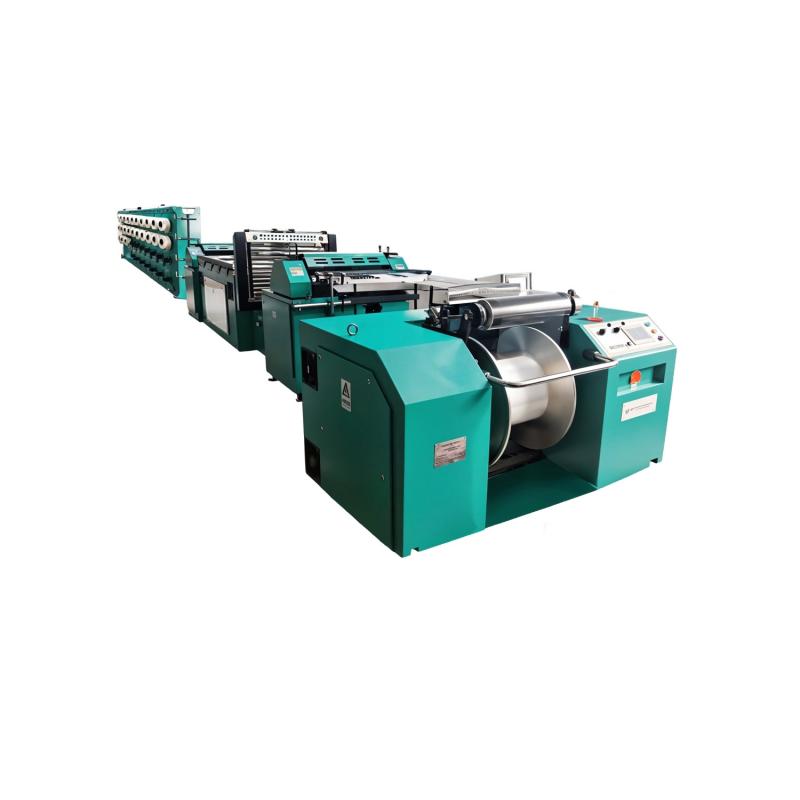
The Split Warping Machine splits mother yarn and winds it directly onto the warp beam in a single pass, instead of splitting on one line and warping on another. Every handoff removed is a set of variables removed: less intermediate storage, a shorter yarn path, and one continuous tension history rather than two stitched together.
For monofilament work the integrated route also removes bobbin pre-staging, which is the step that quietly consumes operator time and floor space in most beam rooms.
- Chemical fiber filaments, low-stretch yarns, acrylic and cotton spun yarns and single filament all run on the same platform.
- High-tenacity work is supported to tensions up to 1600 N, which is what industrial fabrics need before a beam reaches the knitting bed.
- Near-total package utilisation with little to no tail loss, which is where the material saving actually comes from.
Tension control, end by end
Equal tension across all ends is a control problem before it is a mechanical one. A dedicated tension-roller system smooths transient spikes while individual electric creel motors hold each end at its own setpoint, so the machine answers a change in package diameter or friction without an operator reaching for a knob.
Three things around that are worth checking on any warper you evaluate:
- Multi-axis servo drive. Separate servo motors on warper head, levelling roller, draft roller and creel elements let each axis be tuned to the yarn in hand, and avoid the wear pattern that purely mechanical drives develop.
- Laser measurement. High-precision laser devices track winding perimeter and line speed in real time, which is what keeps layer build even and beam edges clean from flange to flange.
- Recipes that carry relationships. A next-generation PLC and touchscreen store tension curves and winding profiles per product family and copy them onto new beams, so a repeat order is set up rather than rediscovered.
That last point is the one most often underrated. Stored settings are what make the 9 a.m. beam and the 9 p.m. beam the same beam.

Configuration: beams, creels and ends
| Item | Standard offering | What it decides |
|---|---|---|
| Beam families | 21×21, 30×21, 21×42 and 30×42 inches | Run length between doffs, and how the beam matches your knitting width plan. |
| Creel | 6 or 7 layers standard, custom racks available | Package capacity and footprint; custom racks matter for specialty yarns or tight floors. |
| Ends | 72 standard, expandable to pattern needs | Whether a new pattern forces a line change or just a recipe change. |
| Split warping | Mother yarn straight into monofilament output | Removes bobbin pre-staging and the handling damage that comes with it. |
| Protection and diagnostics | Power and phase protection; real-time monitoring of tension, drive health, sensors and I/O | How the machine behaves during an outage, and how quickly a fault is located rather than guessed at. |
Which configuration fits your beam room
If you run mainly rigid filament in long, steady campaigns, then put beam format and stored recipes ahead of creel flexibility: your gain sits in changeover time, not in yarn handling.
If spandex or Lycra is anywhere in your mix, then specify the vertical creel with servo support and laser detection first, because elastic damaged during warping cannot be corrected later in the process.
If you currently split mother yarn on a separate line, then compare the integrated route on total handling steps and floor space rather than on warper speed alone.
This section does not apply to beam rooms feeding weaving preparation only. The tension logic carries over, but beam hardness and alignment acceptance criteria there are set by the loom, not by the knitting bed, and should be judged against that standard.
Commissioning and support
Equipment only performs when the people running it trust it. Installations are backed with manuals, video guidance, online sessions and on-site programmes, delivered across more than 20 countries, with regional teams covering Turkey, India, Vietnam, Indonesia and the USA. Those teams run preventive maintenance on a schedule rather than waiting for a stop, which is how small drifts in temperature, yarn lot or floor vibration get caught before they show up in fabric.
Before you compare offers, put three things on one sheet: your yarn families, the beam format you actually need, and the elastic content of your mix. Those three decide creel layout and end count, and the rest of the specification follows from them. Our warping machines overview covers the range, warping creel configurations are set out separately, and beam construction is covered under warp beam. Machine configurations are listed on grandstarcn.com. Send your yarn mix and target beam format through our contact page and we will map settings to your materials.
Frequently Asked Questions
What does a split warping machine do differently?
It splits mother yarn and winds it directly onto the warp beam in one pass, instead of splitting on one line and warping on another. Fewer handoffs means a shorter yarn path, less intermediate storage, and one continuous tension history instead of two joined together.
Why do my beams knit badly when they look fine on the warper?
Because tension drift across ends is not visible in the creel. An uneven traverse or a small tension bump builds a beam that only fails under knitting load, which is why it usually gets blamed on the knitting machine. Individual electric creel motors holding each end at its own setpoint is what prevents it.
Can one warper handle both elastic and rigid yarn?
Yes, with the right creel. The elastic path uses a vertical creel with servo support to reduce yarn-path friction and equalise feed per end, plus laser detectors on the critical passes. Specify that configuration up front if spandex or Lycra is in your mix, because overstretch during warping cannot be corrected later.
What beam sizes and end counts are standard?
Beam families are 21×21, 30×21, 21×42 and 30×42 inches, creels come as 6 or 7 layers with custom racks available, and 72 ends is standard and expandable to pattern needs. Match the beam format to your knitting width plan before anything else.
What tension can the machine hold for technical yarn?
The high-tenacity capability manages tensions up to 1600 N, which covers industrial fabrics that need robust, uniform beams. Confirm the figure against your own yarn during a trial rather than treating it as a universal setting.

Hey, I’m Vincent!
Solving complex challenges with precision and creativity in the warp knitting industry. Passionate about advancing textile engineering and turning innovative ideas into reality. Shaping the future of warp knitting.


