



Jacquard Warp Knitting on the Double Jacquard Raschel 6/2

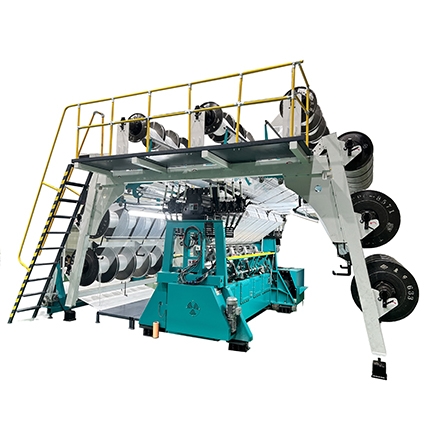
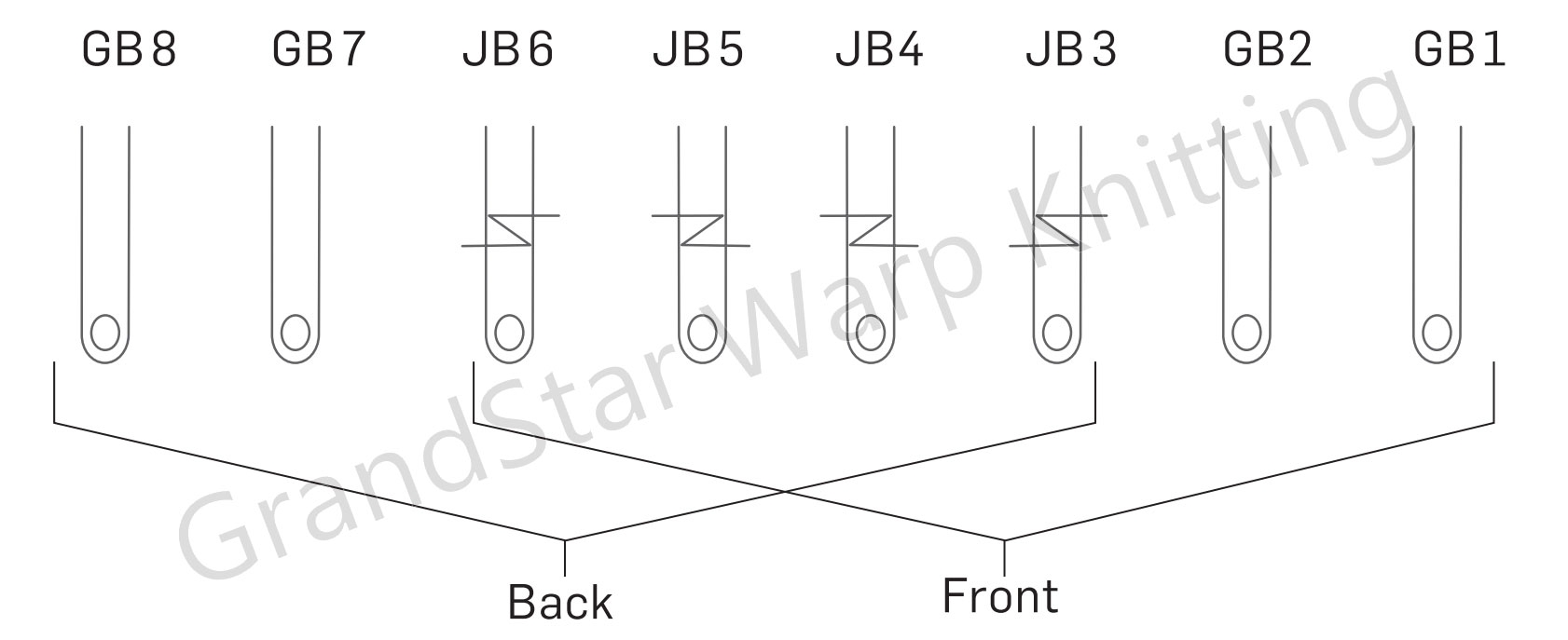
The Double Jacquard Raschel Fabric Machine 6/2 is a two-needle-bar jacquard warp knitting platform: six ground guide bars build the structure, a split-execution piezo-jacquard guide bar does the figuring, and stitch forming runs on GB3, GB4, JB5 and JB6 across both needle bars.
It works 3454 mm (136") wide in E18, E22, E24 or E28. Everything below is the configuration data and what each number actually decides on the floor.
Machine data
| Item | Specification |
|---|---|
| Working width | 3454 mm (136") |
| Gauges | E18, E22, E24, E28 |
| Ground guide bars | 6 |
| Jacquard | Piezo-jacquard guide bar, split execution |
| Needle bars | 2 individual latch needle bars |
| Stitch forming | GB3, GB4, JB5, JB6 on both needle bars |
| Comb bars | 2 knock-over comb bars, 2 stitch comb bars |
| Guide bar drive | Electronic Guide Bar Drive EL, shog up to 150 mm |
| Knock-over comb bar distance | 2-12 mm, continuously adjustable |
| Trick plate | Central, distance readjustable |
| Warp beams | 6 x 812 mm (32"), free-standing |
| Control | GrandStar Command System |
Why the bar count is the specification that matters
Six ground guide bars is the number to read first. Ground bars are what hold the fabric together while the jacquard bar is busy making holes and figure, so a wide ground set is what lets you push aperture size without the structure going slack.
The jacquard bar is a piezo unit in split execution. Split means the jacquard function is divided across the working width rather than driven as one block, which is what gives high-definition motifs with controlled apertures instead of the softened edges you get when jacquard authority is spread too thin.
Stitch forming distributed over GB3, GB4, JB5 and JB6 on both needle bars is the reason hand and selvedge stay consistent when you move between an apparel program and a technical contract. The loop geometry is not being carried by one or two bars working at their limit.
The adjustments that decide the fabric
Two settings do most of the work on this machine, and both are continuous rather than stepped.
The knock-over comb bar distance runs 2-12 mm. That range is what sets the separation between the two fabric faces on double-bar constructions, so it is the primary handle for spacer thickness and for how open a mesh sits. Continuous adjustment matters here because the useful value is rarely a round number.
The central trick plate allows distance readjustment, which is the finer control on knock-over behaviour and loop release. Between the two you can hold weight, hand and openness where the buyer signed off, rather than approximating and hoping the finishing line absorbs the difference.
Guide bar shog of up to 150 mm across all bars, driven electronically, is what makes wide-repeat layouts practical. Pattern change is a file rather than a chain, and the setting returns to the same place on the next run.
Beams and material handling
The machine carries six warp beams at 812 mm (32") in a free-standing arrangement. Six beams is a multi-yarn count: it suits constructions that mix ground, effect and elastic yarns, and it lets you stage colourways without stripping the machine between them.
Free-standing beam support is a maintenance decision more than a knitting one. It keeps operator access clear around the beam area, which is where most of the unplanned stops on a wide raschel actually happen.
What the platform is built to produce
- Jacquard fabrics for garments and home textiles, where motif definition and repeatable hand are the acceptance criteria.
- Mesh and spacer fabrics for sportswear, automotive and industrial use, where openness is engineered rather than incidental.
- Technical textiles including geotextiles, filtration media and reinforced fabrics, where structural stability outranks appearance.
- Lace for fashion and interiors, where pattern fidelity has to hold across a long run.
Is the 6/2 the right machine for your program?
Read this against your own order book rather than against a spec sheet:
- If your work is figured double-bar fabric – spacer, lace, patterned mesh – and you need motif definition without giving up ground stability, then the six-ground-bar plus split piezo-jacquard layout is the part of this machine you are actually buying.
- If you run several yarn types in one construction or stage colourways back to back, then the six-beam capacity is what will decide your changeover time, more than knitting speed will.
- If your gauge requirement sits inside E18 to E28, then the platform covers your range; outside it, this is the wrong frame and no setting will fix that.
Where this does not apply: single-needle-bar work, and flat commodity fabric with no figuring, are not what this configuration is for – the jacquard and second needle bar would be paid for and idle. Gauge and width are frame decisions fixed at order time, so they belong in the configuration review, not in a later upgrade.
Installation, training and after-sales
Installation and operator training are delivered as part of the machine program, covering setup, pattern adjustment, preventive care and daily operating routine, in several formats.
After-sales service operates locally in Turkey, India, Vietnam, Indonesia and the USA, with further countries planned. Local presence matters most in the first weeks on a new style, when the questions are small and frequent and a shipping-time response is not useful.
To take this further, the practical next step is a configuration review: map your target fabrics to gauge, guide bar setup and beam plan, then agree the training path from that. Send your fabric targets and we will work back to the machine specification.
Frequently Asked Questions
What is the working width and gauge range of the Double Jacquard Raschel 6/2?
The machine works 3454 mm (136 inches) wide and is available in gauges E18, E22, E24 and E28. Width and gauge are frame decisions fixed when the machine is configured, so they need to be matched to your target fabrics before the order rather than adjusted later.
How many guide bars does it have?
Six ground guide bars plus a piezo-jacquard guide bar in split execution. Stitch forming runs on GB3, GB4, JB5 and JB6 across two individual latch needle bars, and there are two knock-over comb bars and two stitch comb bars supporting knock-over and loop release.
How thick a spacer fabric can it make?
The knock-over comb bar distance is continuously adjustable from 2 to 12 mm, which is the setting that governs separation between the two fabric faces. The central trick plate allows further distance readjustment for finer control. Actual achievable thickness also depends on yarn and construction, so confirm it against a sample rather than against the range alone.
How many warp beams does the machine take?
Six warp beams of 812 mm (32 inches), in a free-standing arrangement. That count supports multi-yarn constructions and staged colourways, and the free-standing layout keeps operator access clear around the beam area.
What kind of jacquard warp knitting fabrics is it used for?
Jacquard fabrics for garments and home textiles, mesh and spacer fabrics for sportswear, automotive and industrial applications, technical textiles such as geotextiles, filtration and reinforced fabrics, and lace for fashion and interior use.

Hey, I’m Vincent!
Solving complex challenges with precision and creativity in the warp knitting industry. Passionate about advancing textile engineering and turning innovative ideas into reality. Shaping the future of warp knitting.


