



Glass Fiber Warp Knitting Machine: A Specification Checklist

Most disappointing glass fiber warp knitting machine purchases fail on three things that were knowable before the order: the machine was specified against a nameplate rather than an application, the control package was never validated with real data, and the site was not checked against the machine’s actual requirements. This checklist covers all three, in the order they matter.
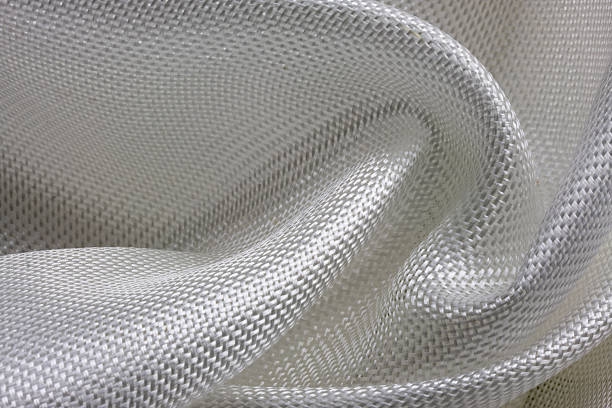
Specify by application, not by nameplate speed
When a composite line misses delivery dates, the cause is usually upstream of the knitting head. Inconsistent yarn tension produces variable lay-up. Weak batching control leaves surface marks that only appear after cutting. Thin training stretches ramp-up from weeks into months. Power quality and site conditions carry more weight than most project teams assume, and they are the cheapest items to get right before installation and the most expensive to fix after.
Before comparing machines, fix the application: working width, gauge and reinforcement style for the parts you actually make, whether that is wind-power blade material, cabin covers or aerospace structures. Everything below is judged against that, because a control feature that does not serve your lay-up is capacity you are paying to own.
Core specification and what each item controls
Our biaxial warp knitting machine and chopped biaxial platforms are built for composite textiles, with the design weighted toward steady lay-up, gentle material handling and a clean surface finish, because those three decide downstream efficiency from cutting through infusion.
| Item | Specification | Why it matters |
|---|---|---|
| Working widths | 2565 mm (101 in) and 4496 mm (177 in) | Matches the common composite formats; width chosen after the part, not before it. |
| Gauge | E7 | Supports dependable fiber architecture at the densities composite lay-up expects. |
| Knitting elements | Compound needle bar, closing wire bar, knock-over sinker bar, supporting bar, counter retaining bar, two ground guide bars | Rigid support is what keeps fiber paths stable as production speed rises. |
| Patterning | N-drive with pattern disc, integrated tempi change gear drive, one pattern disk | Simple and repeatable setup, which matters more than pattern range on reinforcement fabric. |
| Warp beam support | Two positions for sectional use | Determines run length between changeovers on wide formats. |
These are building blocks for reproducible fabric quality rather than brochure checkboxes. The combination of E7 gauge, controlled patterning and rigid support elements is what holds fiber paths steady when the line speeds up, and it is the reason customers running critical composite programmes describe the output as predictable.
Controls, drives and power draw
Precision lives in the controls. Each mounted warp beam position uses electronically controlled yarn let-off driven by geared motor and frequency converter, and fabric take-up is electronic as well with matching drive architecture, so tension and course length stay predictable together rather than fighting each other. Yarn stop motion is available electronically, which catches a defect at the source instead of at inspection.
- Servo-controlled weft insertion and servo-controlled chopper keep reinforcement placement repeatable at higher throughput, which is the single item to test with your own material during a trial.
- A dedicated machine control computer orchestrates main drive, yarn feeding and take-up, with production data shown on a touchscreen in the switch cabinet so adjustments are made from evidence.
- Electrical package includes a speed-regulated drive, power-failure safe design and an inching motion for safe threading, with core functions under single-speed control through a frequency converter.
- Power draw is 13 kW main motor for widths from 2000 to 4400 mm and 18 kW from 4400 to 6000 mm. Lubrication is immersion type with filtration.
Site conditions people underestimate
Plan the room for about 25 degrees Celsius, plus or minus 2 degrees, at 65 percent relative humidity. Avoid drafts and protect the machine from dust and fiber fly, which is the quiet enemy of surface finish on composite fabric. Floor loads run from 2000 to 4500 kg per square metre depending on machine type and length, and operational vibration has to be considered in the layout, particularly around large rolls.
The batching device stands separately and uses friction drive with a pressure roller, supports a maximum batch diameter of 914 mm (36 in), and is geared-motor driven with an integrated frequency converter so batching stays matched to stitch courses. Batching is where a mechanically sound machine can still lose surface quality, so treat it as part of the machine rather than as an accessory decided later.
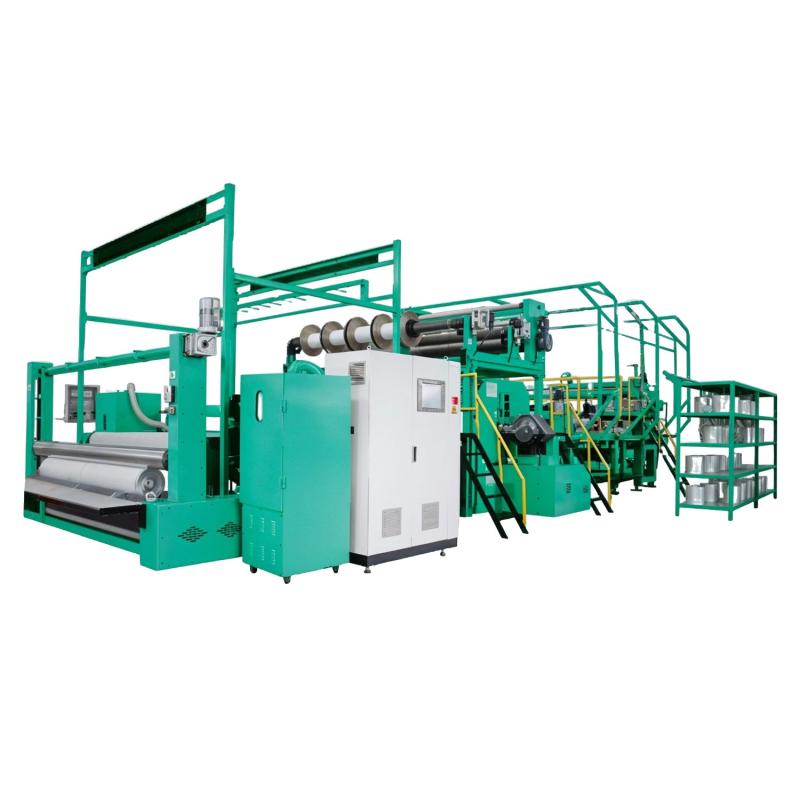
Which configuration fits your programme
If your parts are wide, such as wind-power material, then start from the 4496 mm width and the 18 kW power provision, and confirm your floor load before the layout is drawn rather than after.
If your programme depends on chopped reinforcement, then the servo-controlled chopper and weft insertion are the items to validate with your own glass during a trial, because placement repeatability at speed is what your infusion step inherits.
If you are replacing an older line rather than adding one, then audit the room first: temperature stability, humidity, dust and vibration frequently explain more of the old line’s defect rate than the old machine did.
This section does not apply to apparel or home textile programmes. The elements listed here are chosen for reinforcement fabric, where dimensional accuracy outranks hand feel; a fabric judged on drape and surface should be specified against different criteria entirely.
Service, training and lifecycle support
A machine this specialised only pays off when operators trust it, so the after-sales model concentrates on skills rather than only on spare parts: professional manuals, online guidance, a video library, and on-site training built around your crew and shift pattern. On-site training has been delivered in more than 20 countries, with local service teams in Turkey, India, Vietnam, Indonesia and the USA. Where there is no local team, support starts online in real time and engineers are dispatched from the nearest hub when the work needs hands.
Uptime protection is scheduled rather than reactive. Engineers visit every one to two months to review performance, advise on maintenance and confirm that operating conditions are still inside specification. That rhythm catches temperature drift, a new yarn lot or fresh floor vibration before any of them turns into a fabric defect.
If you are planning a line now, send the part, not the machine name: the reinforcement style, the width you need and the throughput you are committing to. Related configurations are set out under multi axial warp knitting machines and composite warp knitting machines, with the full machine listing on grandstarcn.com. Reach us through the contact page for an application review and a commissioning plan matched to your plant.
Frequently Asked Questions
What gauge and working widths are available?
Gauge E7, with working widths of 2565 mm (101 in) and 4496 mm (177 in) covering the common composite formats. Choose the width from the part you are making and the throughput you have committed to, not from the headline machine speed.
How much power does the machine need?
A 13 kW main motor for widths from 2000 to 4400 mm, and 18 kW for 4400 to 6000 mm. Lubrication is immersion type with filtration. Confirm the provision during layout, since it is far cheaper to plan than to retrofit.
What room conditions does a glass fiber warp knitting machine need?
About 25 degrees Celsius plus or minus 2 degrees at 65 percent relative humidity, with drafts avoided and protection from dust and fiber fly. Floor loads run 2000 to 4500 kg per square metre depending on machine type and length, and vibration has to be considered in the layout.
What controls the accuracy of weft placement?
A servo-controlled weft insertion system and a servo-controlled chopper, working with electronically controlled let-off at each beam position and electronic take-up. Test this combination with your own glass during a trial, because your infusion step inherits whatever placement variation it leaves.
How large a roll can the batching device take?
Maximum batch diameter is 914 mm (36 in). The device stands separately, uses friction drive with a pressure roller, and is geared-motor driven with an integrated frequency converter so batching stays matched to stitch courses. Surface marks often originate here rather than at the knitting head.

Hey, I’m Vincent!
Solving complex challenges with precision and creativity in the warp knitting industry. Passionate about advancing textile engineering and turning innovative ideas into reality. Shaping the future of warp knitting.


