



Warp Knitting Machine Market: Families, Regions, Supplier Checklist

The warp knitting machine market divides along two lines: by machine family and by region. The family you need is fixed by the fabric you sell, and the region decides which suppliers can reach you with engineers rather than only with a brochure. This page lays out both splits as we see them from the supply side, then gives a checklist for judging any supplier in this market.
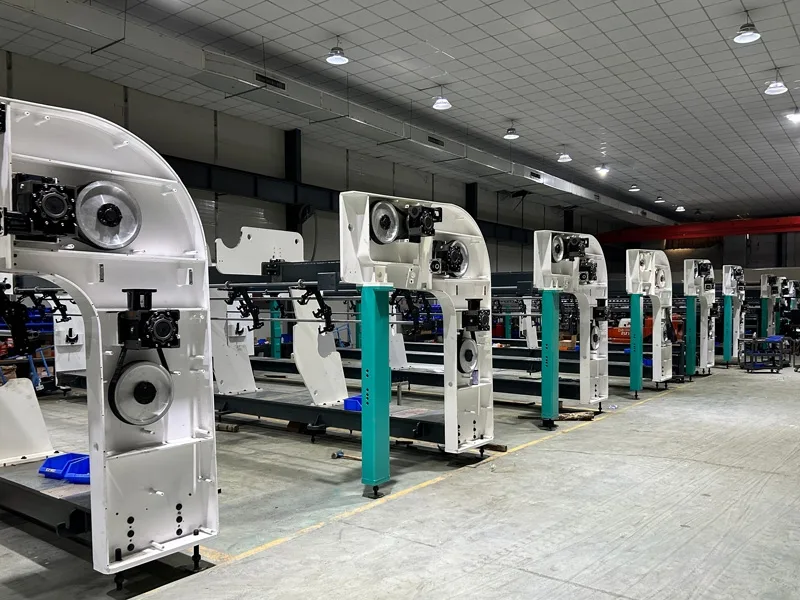
How the market divides by machine family
Two families cover almost everything sold. Tricot machines, offered with two, three or four guide bars, make the flat fabrics used in apparel, linings, automotive and home textiles. Raschel machines, in single needle bar and double needle bar configurations, make everything from delicate lace to heavy netting and technical structures.
Within raschel, the double needle bar version is the one that opens up thick, three-dimensional fabrics. For the full family tree and what each configuration is bought for, see our pages on warp knitting machine types and single versus double needle bar raschel.
The family choice comes before the supplier choice. A supplier strong in tricot is not automatically strong in double needle bar raschel, and the service engineers who know one rarely know the other equally well.
Where the machines are built and where they are bought
Our own footprint is a fair sample of the market. Grand Star builds its machines at its headquarters in Fujian, China. The buyers are spread across the United States, Japan, Turkey, Vietnam, Indonesia, India, Colombia and Mexico.
That spread tells you two things about the market. First, demand sits where fabric is knitted for export garments, home textiles and technical end uses, not only where the machines are made. Second, a supplier has to be able to support a machine far from its factory, which is why after-sales presence counts for more than it looks in the first conversation.
What buyers in this market ask for
The requests that come up in nearly every enquiry fall into four groups:
- Adjustable gauge and stitch density. Mills want one machine base that can run lightweight, open fabrics and dense, durable ones, because their order book changes faster than their machine park.
- Material range. The same machine is expected to handle cotton, silk, nylon and polyester without a rebuild, so a mill can take new fabric styles without buying a second line.
- Mechanisms that cut operator intervention. Automated warp beam displacement, precise yarn feeding, adjustable needle vibration and handlebar height control are the items buyers now put on the specification sheet rather than treat as options.
- Winding that does not waste fabric. A fabric winding system that keeps interlooping smooth reduces downtime and material waste, and buyers increasingly ask to see it running before they sign.
Energy use has joined that list. Buyers compare power draw per metre between candidate machines because electricity is now a visible line in their cost per roll, and lower consumption is also the easiest sustainability claim to prove to their own customers.
A checklist for judging a supplier in this market
Four questions separate a supplier who will still be there in year five from one who will not.
- In-house control. Does the supplier design and build the core mechanisms itself, or assemble bought-in units? In-house control is what lets a supplier fix a fault in the drive or the let-off instead of referring you to a third party.
- Quality systems. Ask how uniform stitch formation is checked before a machine ships, and ask to see the record, not the policy.
- Market history. Which fabric families has the supplier actually delivered, and in which countries? A machine that has only run one kind of fabric in one climate has not been tested.
- After-sales. Where are the engineers based, and how do they reach you? Distance is measured in days of lost production, not in kilometres.
If you are buying your first warp knitting machine, then weight after-sales and training above every other item on this list, because your own team cannot yet cover a gap in support.
If you are adding capacity to an existing park, then in-house control and market history matter most, because you already know what breaks and you need a supplier who can fix that part.
This checklist does not apply to buying a used machine from a broker. There the questions shift to the machine’s own history, and our used machine inspection checklist is the better guide.
Where Grand Star sits
Grand Star makes both families, tricot with two to four guide bars and raschel in single and double needle bar form, and supports them from Fujian into the markets listed above. The product range is listed on grandstarcn.com. The pages on this site explain how to choose within each family; the group site is where the machines themselves are specified.
If you want to place a specific fabric into this map and find out which family and configuration it belongs to, send the fabric target through our contact page and we will answer with a configuration rather than a sales call.
Frequently Asked Questions
What are the main types of warp knitting machine on the market?
Two families cover almost everything: tricot machines with two, three or four guide bars for flat apparel and home textile fabrics, and raschel machines in single or double needle bar form for lace, netting and technical fabrics. The double needle bar raschel is the one used for thick, three-dimensional structures.
Where are warp knitting machines made and sold?
Grand Star builds at its headquarters in Fujian, China, and ships to buyers in the United States, Japan, Turkey, Vietnam, Indonesia, India, Colombia and Mexico. Demand sits where fabric is knitted for export, so support far from the factory is part of the purchase.
What should I check before choosing a supplier?
Four things: whether the supplier designs and builds its core mechanisms in-house, how it checks stitch uniformity before shipping, which fabric families and countries it has actually delivered to, and where its service engineers are based. For a first machine, weight after-sales and training highest.
Which features do buyers ask for most?
Adjustable gauge and stitch density, compatibility with cotton, silk, nylon and polyester, mechanisms that reduce operator intervention such as automated warp beam displacement and precise yarn feeding, a winding system that limits waste, and lower energy use per metre.

Hey, I’m Vincent!
Solving complex challenges with precision and creativity in the warp knitting industry. Passionate about advancing textile engineering and turning innovative ideas into reality. Shaping the future of warp knitting.


